How Octant Evaluates
an Organization.
The Octant AI Reality (AIR) Index℠ scores eight AIR-O dimensions on evidence, isolates the constraints holding back AI investment, and sequences the work to clear them. It is the instrument behind every engagement.
Five steps, in order.
Every Octant engagement follows the same five steps. The recommendation is the last thing we produce, not the first.
We set what the diagnostic covers and where its boundaries sit before any evidence is gathered.
We gather structured evidence from executive interviews and documents.
Octant advisors score each condition against a defined rubric, so every score can be explained.
The scores expose the binding constraints, the conditions holding back everything else.
We sequence the work so nothing is scheduled before the thing it depends on has moved.
One diagnosis. Three integrated lenses.
The AI Reality (AIR) Index evaluates the organization first. When the evidence warrants, it opens a deeper look at the technology or the leadership behind it.
Can the organization convert AI investment into performance?
The base diagnostic. Eight organizational dimensions, scored by Octant advisors, that determine whether strategy, governance, operating model, and culture can turn AI spend into results.
Can the technical foundation support AI at the scale you intend?
Data, architecture, security, and deployment, judged against the stage you operate in.
Below the decision threshold, a discussion opensCan the leaders responsible drive the change?
A structured evaluation of whether the leaders accountable for AI can carry the transformation at scale.
Below the decision threshold, a discussion opensAIR-O is the starting point → a D04 sub-score or the D06 score below the decision threshold opens an AIR-T or AIR-L discussion. Each is a separate engagement and proceeds only with the client’s approval
Eight dimensions.
One index.
The Organizational Lens scores eight dimensions, each scored from 1.0 to 5.0, to one decimal place, on evidence by Octant advisors. A weakness in any one constrains performance across the rest, however strong the others.
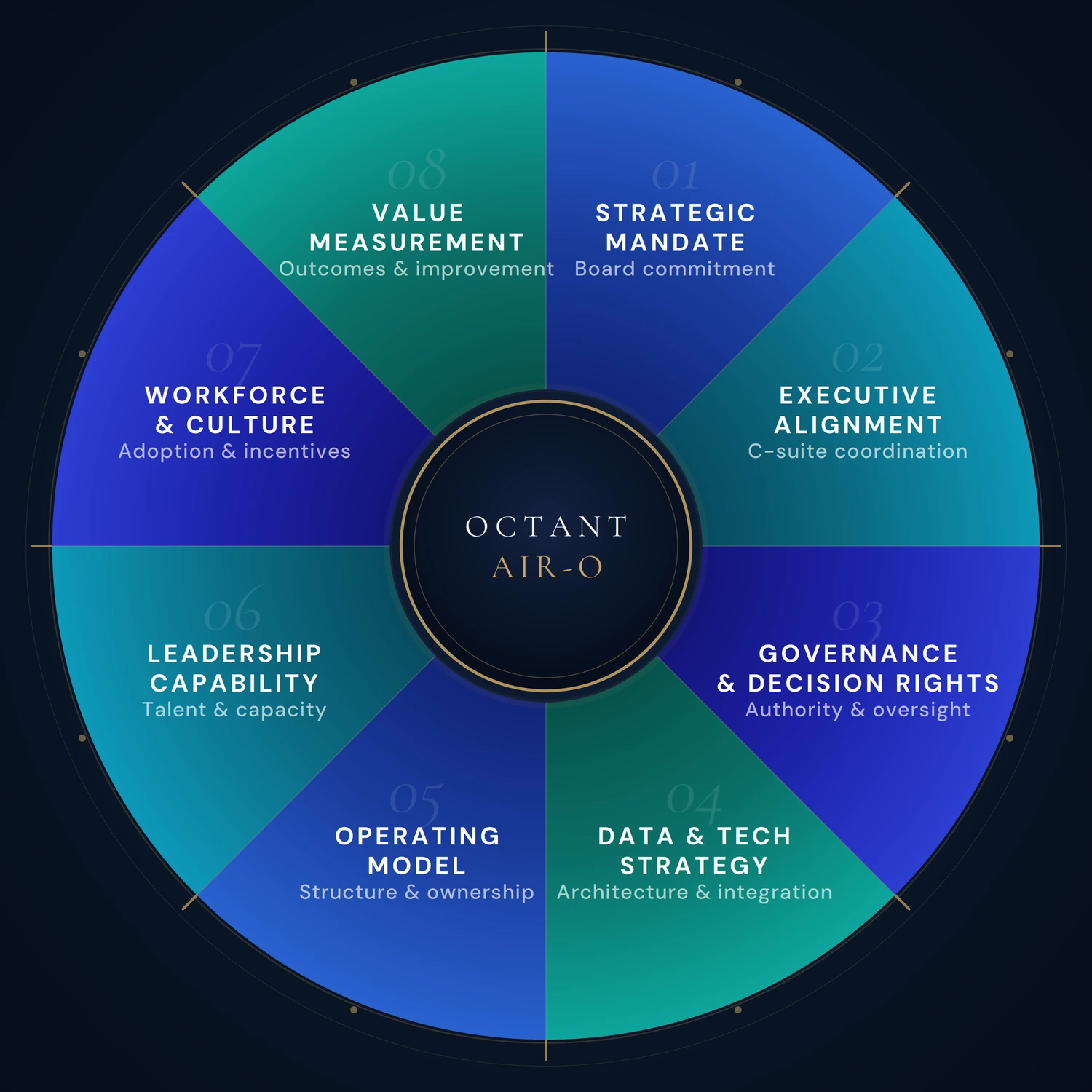
Each dimension is scored from 1.0 to 5.0, to one decimal place. D04 and D06 are gating: either one at or below the gate caps the profile.
Four gaps, mapped to the
dimensions that locate them.
A leadership team feels four things going wrong. The eight dimensions locate where each one starts.
Has the board defined what AI must accomplish?
Can the leadership team drive the required change?
Can the organization govern, scale, and adopt it?
Can value be measured and attributed?
Symptom and cause rarely sit in the same place. The dimensions are where the cause is found.
Four rules that keep
the diagnosis independent.
We don't build or implement the technology. Our finding on what to fix isn't sized to win an implementation contract. Independence is the point, and four rules keep it that way.
Every score is assigned by Octant advisors from evidence. Clients cannot inflate their own assessment. Thresholds are fixed before the engagement begins and shared with the client at scoping.
When interview scores from two leaders on the same dimension differ beyond the material-variance threshold, the gap is flagged as material and reported as a finding in its own right.
Most of every engagement is spent finding constraints. Prescription comes only after the evidence is in.
The Transformation Plan is ordered by which constraints matter most, because earlier actions make later ones possible.
Every recommendation must be traceable to diagnostic evidence.
Scores come from advisor-reviewed evidence.
Vs. a self-reported maturity survey.
The Transformation Plan sequences the binding constraints in the order that clears the path to performance.
Vs. a ranked list of high-impact items.
Value is baselined before deployment.
Vs. ROI estimated after the fact.
What a finding
looks like.
The diagnosis produces a board-ready artifact. Here is one page from it: the executive-variance heatmap.
| Dimension | Leader A | Leader B | Leader C | Leader D | Leader E | Leader F | Spread |
|---|---|---|---|---|---|---|---|
| 01 Strategic Mandate | 3.8 | 3.6 | 3.1 | 3.3 | 3.9 | 3.2 | 0.8 |
| 02 Executive Alignment | 4.2 | 2.1 | 1.2 | 2.4 | 3.1 | 2.0 | 3.0 |
| 03 Governance & Decision Rights | 2.2 | 2.4 | 2.8 | 1.9 | 2.1 | 1.4 | 1.4 |
| 04 Data & Technology Strategy Gating | 3.1 | 3.7 | 4.1 | 3.8 | 2.9 | 3.6 | 1.2 |
| 05 Operating Model & Structure | 2.0 | 1.4 | 2.2 | 1.8 | 2.1 | 1.9 | 0.8 |
| 06 Leadership Capability Gating | 2.4 | 2.1 | 1.3 | 2.2 | 3.0 | 2.3 | 1.7 |
| 07 Workforce & Culture | 2.9 | 3.6 | 2.7 | 3.1 | 3.8 | 3.0 | 1.1 |
| 08 Value Measurement | 1.3 | 2.1 | 1.8 | 1.6 | 1.2 | 1.9 | 0.9 |
Scroll sideways for the remaining leaders and the spread column.
On Executive Alignment, Leader A scored 4.2 and Leader C scored 1.2, three points apart. That spread is reported as a finding in its own right, and it sets the first interview the moment scoring closes. Scores here are illustrative. The rubric behind them, the weighting, and the variance thresholds are applied inside the engagement. Leader names and roles are masked in every readout.
Illustrative profile. Every engagement's artifact is built from its own evidence. Request an executive briefing to walk through a full readout →
Know What Must Change
Before You Commit More Capital.
The Organizational Lens applies the AI Reality (AIR) Index to your organization's conditions and returns a scored assessment, a map of the binding constraints, and a Transformation Plan, built on evidence.