Octant Advisory | Independent AI Diagnostics & Governance
Convert AI investment into measurable performance.
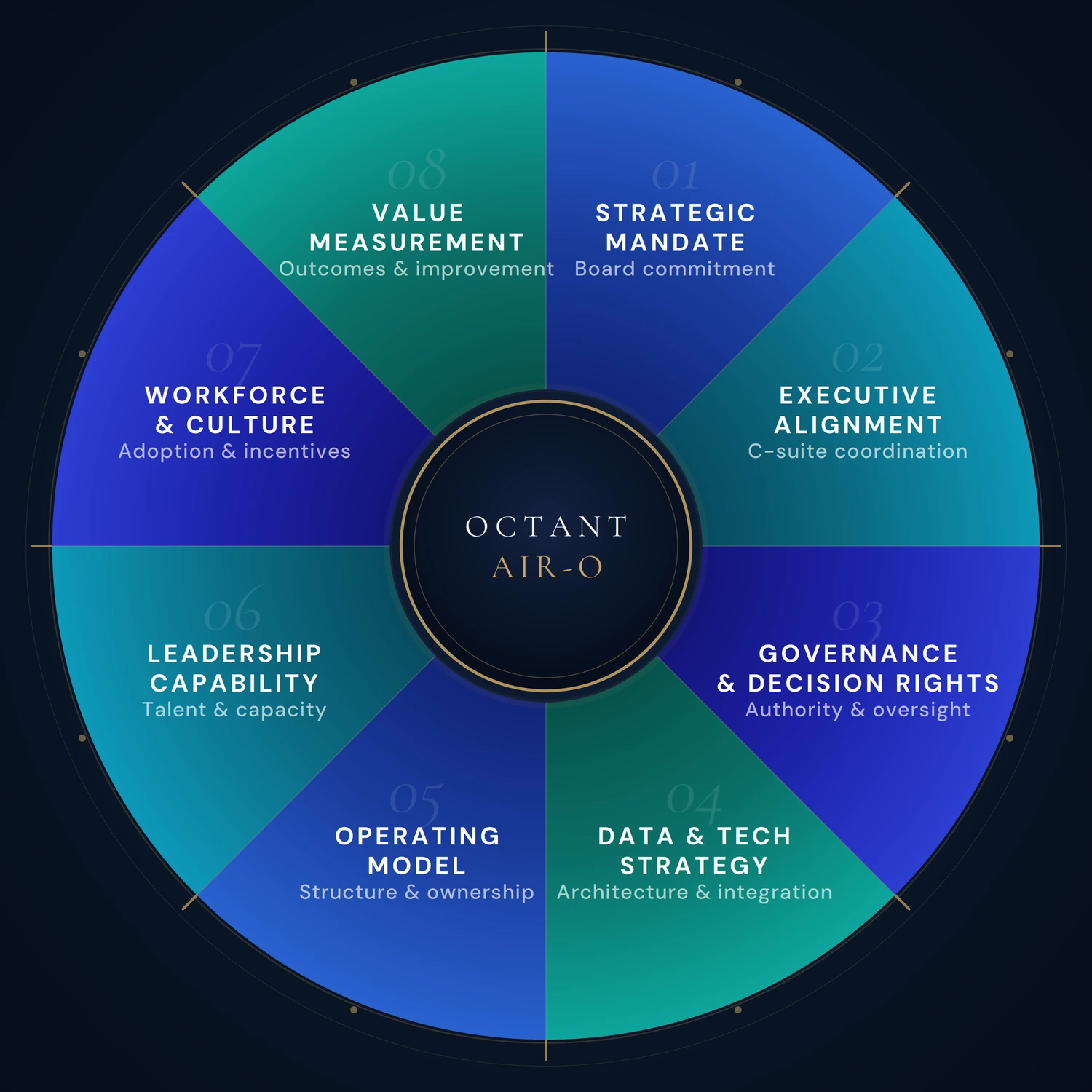
Octant scores the eight organizational conditions AI performance depends on, against a five-level maturity scale, using your policies, program documents and executive interviews. You receive the scores, the evidence behind each one, and a transformation plan that sets out what to address first and what follows.
Octant sells no software and does not bid on the implementation work the plan calls for.
Mandate, executive alignment, governance and decision rights, data and technology strategy, operating model, leadership capability, workforce, and value measurement.
The AI Performance Gap
Four places an AI program stalls.
Nobody can say who decides. Governance built to control risk now slows every decision that matters. Pilots reach production with no baseline to measure against, so nobody can prove what they returned. These are organizational faults, and they do not respond to a better model. Octant names which one is binding in your organization, before more capital and executive credibility go in behind it.
Mandate
Has the board funded a named AI ambition (Reinvent, Expand or Improve) tied to outcomes someone is accountable for?
Leadership
Are the accountable leaders aligned and equipped to drive transformation at scale?
Execution
Can the governance, operating model, data strategy, and workforce support deployment?
Performance
Are outcomes baselined, measured, and connected to investment decisions?
The Evidence
“I’ve been part of hundreds of AI initiatives and talked with thousands of executives running them. AI underperforms when the technology gets deployed into an organization that isn’t ready to support it. The mandate, the leadership, the governance, data strategy, and operating model have to come first.”
Dr. Ian McCulloh · Co-Founder
Two scores on every dimension.
AI work stalls when authority, ownership and measures are unclear. The AIR-O examines those conditions, records the evidence and sets out what must change first.
Your executives rate each dimension, which gives the Claimed score. Octant scores the same dimension from inspected artifacts and traced decisions, which gives the Evidenced score. The distance between the two is the Reality Gap.
Where To Begin
The AI Reality Diagnostic
Every dimension flagged for constraint analysis is tested against the binding-constraint criteria. What survives that test sets the order of the Transformation Plan, and what does not survive is reported as a weakness rather than a cause.
You leave with
✓ The binding constraints, and which one has to be addressed first
✓ Where your leadership team disagrees, and by how much
✓ A Transformation Plan in the order the work has to happen
✓ A named owner and a decision date against every item in it
✓ A report your board can use without a translator
One diagnostic framework. Three integrated lenses.
Every Octant engagement uses the same evidence standard and five-level maturity scale.
AIR-O℠ · Organizational Lens
Measures the enterprise conditions required for AI to perform: mandate, executive alignment, governance and decision rights, data and technology strategy including build-buy-partner authority and vendor governance, operating model, leadership capability, workforce, and value measurement.
Examines whether the organization’s data strategy and technical foundations can support secure, scalable, production-grade AI.
AIR-L℠ · Leadership Lens
Evaluates whether the leaders responsible for transformation have the capabilities required to deliver it.
Most engagements begin with AIR-O. When the evidence reveals a deeper technology or leadership constraint, AIR-T or AIR-L provides the next level of diagnosis.
Octant scores what leaders report in interviews and the survey to produce the Claimed score, and scores inspected evidence to produce the Evidenced score. No technology sales agenda, and no implementation contract waiting behind the findings.
What an Octant Diagnosis Changes
What the leadership team can decide afterward.
An Octant engagement puts the following in front of the leadership team, scored and sourced:
✓ Whether the organization is ready to scale AI
✓ Why otherwise promising initiatives are stalling
✓ Which risks require board or executive action
✓ Where additional investment would, and would not, produce value
✓ Which organizational changes must precede technology deployment
✓ How progress and returns should be measured
Target Markets & Strategic Use Cases
Three markets where Octant works.
Private Equity & Portfolio Operations
FocusPre-acquisition diligence and platform value creation.Commercial valueEmpirical technical and organizational evaluation of target assets prior to close, identifying structural risk, technical debt and actionable post-close AI integration pathways.Key scenariosPre-deal capability diligence, post-merger integration validation, portfolio-wide AI maturity benchmarking.
Healthcare & Financial Services
FocusInstitutional governance, defensibility and high-consequence controls.Commercial valueIndependent diagnostics for highly regulated operating models where data lineage, model validation, fiduciary risk and operational resilience are paramount.Key scenariosWorkflow handoff integrity, model risk governance alignment, institutional compliance frameworks.
Government Contractors, Defense & Aerospace
FocusProgram feasibility, prime delivery and proposal defensibility.Commercial valueStrategic baseline diagnostics for contractors embedding advanced AI architectures into major program bids, prime execution and mission workflows.Key scenariosProgram baseline diagnostics, technical and organizational delivery feasibility, delivery risk quantification.
Executive Search & Strategic Talent Advisory
FocusExecutive mandate scaffolding and organizational design.Commercial valueDiagnostic profiling of an organization’s baseline maturity to define precise leadership mandates, align board expectations and de-risk critical executive placements. Octant does not run searches.Key scenariosAI leadership organizational scoping, talent architecture evaluation, leadership transition alignment.
Why Octant
Diagnostic independence.
01 Evidence-based, artifact-driven evaluation
We evaluate verifiable operational artifacts: data pipelines, governance policies, workflow handoffs and delivery workflows, to establish your true organizational baseline. Every dimension is scored by two qualified scorers against a locked evidence ledger.
02 Consulting rigor with sector depth
Both founders are Accenture alumni. Ian McCulloh was Chief Data Scientist at Accenture Federal Services and now directs AI Executive Education at Johns Hopkins. Maria Chaloux led executive recruiting there and built the leadership team behind its AI practice. We combine management consulting methodology with technical and mission-critical execution experience across regulated commercial verticals and defense contractor environments.
03 Diagnostic independence
We do not sell software licenses or monetize downstream systems integration. Our findings serve Boards, C-suite executives and operating partners. Where a material referral or commercial relationship exists, Octant discloses it in writing before the engagement begins.
04 Built for executive action
The diagnostic translates evidence into decisions: what to fund, change, stop, govern or hire, and in what sequence. Findings arrive with named owners and decision dates.
For Consultancies, Integrators, PE Firms, Executive Search Firms, and Platform Providers
Give your client an independent diagnosis.
Octant scores the organization, documents the findings and leaves implementation work to the partner.
Former Chief Data Scientist at Accenture Federal Services and now Director of AI Executive Education at Johns Hopkins. Carnegie Mellon PhD in computer science and AI, author, and retired U.S. Army lieutenant colonel.
Maria Chaloux
Co-Founder & Managing Partner
Former executive recruiting leader at Accenture Federal Services, where she built the leadership team behind its AI practice. Two decades assessing what enterprise transformation roles require. SHRM-SCP and psychometric-assessment certified.
“The AI practice Ian helped build at AFS delivered some of the most consequential AI programs across all 15 cabinet-level federal agencies and represents some of the most advanced applications of AI deployed by the U.S. Government.”
LTG (Ret.) Susan Lawrence
President & CEO, AFCEA International · Former CIO, U.S. Department of the Army
“Ian has been a driving force in scaling AI and data science capabilities across both the private and public sectors. His ability to navigate complexity, build high-impact AI organizations, and deliver results consistently sets him apart.”
Amir Bagherpour, PhD
Managing Director, Agentic AI, Accenture
Begin With the Evidence
Know what is keeping your AI investment from performing.
Most executive teams already suspect where the problem is. What they do not have is evidence the rest of the leadership team will accept, and an order of operations that follows from it.
A founding partner will respond within one business day.
Request Executive Briefing
Begin the Conversation
Tell us about your organization. We'll respond within one business day.
✶
Request Received
Thank you. A member of the Octant Advisory team will be in touch within one business day.